What Is a Marketing Funnel and How to Use One to Grow
Learn what a marketing funnel is, how each stage works, and how Bakersfield businesses can use one to generate more leads and dominate their market.
Imagine having a system that takes complete strangers and turns them into loyal, paying customers almost on autopilot. Sounds pretty great, right? Well, that is exactly what a marketing funnel can do for your business.
If you have ever wondered why some businesses seem to effortlessly attract and convert customers while others struggle to make a single sale, the answer usually comes down to one thing: their funnel. A marketing funnel is a step-by-step framework that guides potential customers from the moment they first discover your brand all the way through to making a purchase.
The best part? You do not need to be a marketing expert to build one. Whether you are just starting your first business or trying to grow an existing one, this tutorial will walk you through everything you need to know. We will break down what a marketing funnel actually is, explain each stage in simple terms, and show you practical steps to build one that works for your specific goals. By the end, you will have a clear roadmap to start turning visitors into customers with confidence.
What Is a Marketing Funnel?
Think of a marketing funnel as your business's GPS for turning strangers into loyal customers. It's a framework that maps the complete journey a potential customer takes, starting from the very first moment they hear your name all the way through to buying from you, coming back again, and eventually telling their friends about you. Without that map, you're basically driving without directions and hoping you end up somewhere useful.
The concept has been around for over a century, and it's stuck around because it works. According to a complete breakdown of funnel stages, advertisers who adopt a full-funnel approach see up to three times more brand awareness and double the conversions compared to businesses that focus on just one stage. That's not a small difference. That's the gap between a marketing strategy that builds something real and one that just burns budget.
The four core stages are Awareness, Consideration, Decision, and Retention, and each one needs a completely different approach. Awareness is about getting found. Consideration is about earning trust. Decision is about making it easy to say yes. Retention is about keeping customers coming back so you're not constantly starting from scratch. Each stage requires a different message, a different tactic, and honestly, a different mindset.
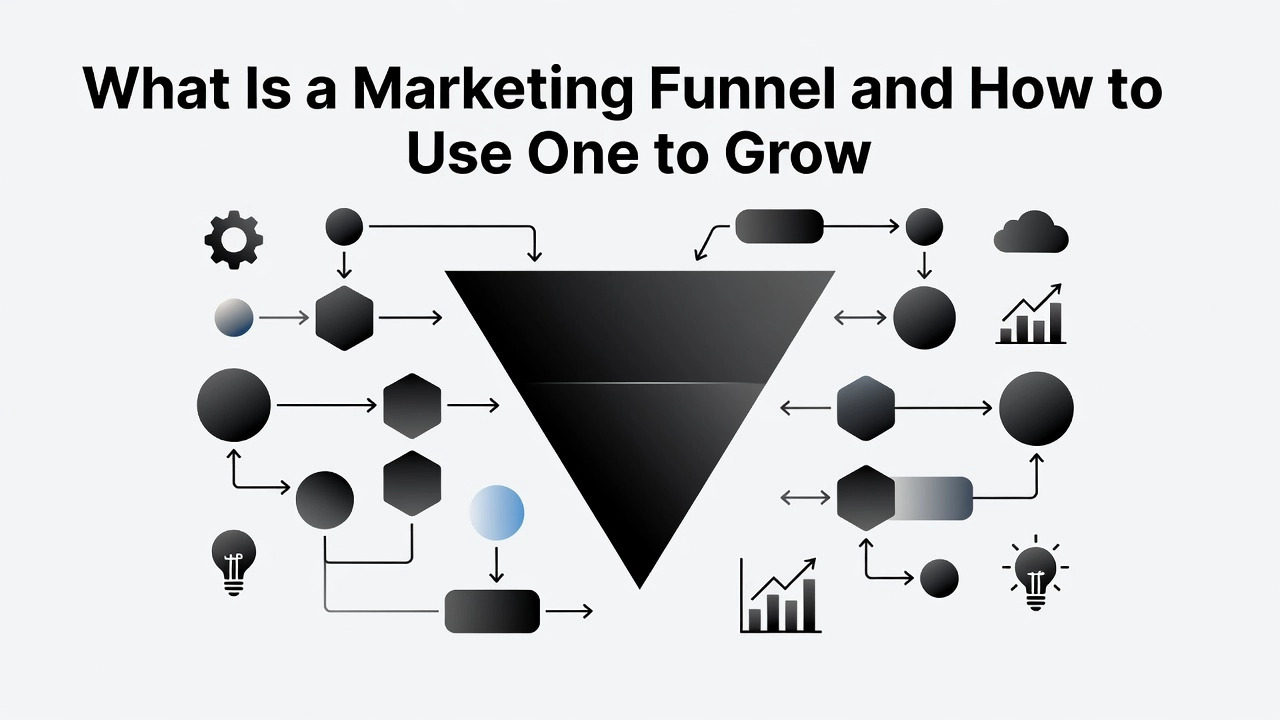
The funnel shape itself tells an important story. A wide pool of people discovers your business at the top, and a smaller, more qualified group makes it to the bottom. That narrowing is completely normal and expected. Not everyone who sees your Facebook ad is ready to hire you today, and that's okay.
Here's where most local businesses run into trouble. Without a funnel connecting everything together, your marketing becomes a collection of disconnected moves: a social post here, a paid ad there, maybe a Google listing you haven't updated in two years. None of it is talking to the other pieces, and none of it has a clear job to do. Building and optimizing a proper marketing funnel is what transforms those scattered tactics into a system that actually moves people forward.
For a Bakersfield HVAC company, a local law firm, or a home services contractor, a funnel means every marketing dollar has a purpose. Your SEO content builds awareness. Your retargeting ads bring back people who were considering you. Your reviews and testimonials close the deal. And your follow-up keeps customers loyal. That's not complicated. That's just smart.
Stage 1: Awareness — Getting Found by the Right People
The awareness stage sits at the very top of your marketing funnel, and it's exactly what it sounds like: this is the moment someone first discovers your business exists. Here's the thing though, most of the time they're not even searching for you specifically. They're searching for a solution to a problem. Nearly 96% of website visitors aren't ready to buy when they first find you, which means awareness isn't about closing deals. It's about filling your pipeline with the right people so the rest of the funnel has someone to work with.
SEO: Your Organic Awareness Engine
When a homeowner in Bakersfield types "best HVAC company near me" into Google, or someone who just got into an accident searches "personal injury lawyer Bakersfield," the businesses that show up on page one are the ones that enter that person's world. Everyone else is invisible. That's why SEO is the backbone of organic awareness for local businesses. It intercepts potential customers at the exact moment they're recognizing a problem, before they've committed to any solution. A well-optimized Google Business Profile, consistent local citations, and a steady stream of reviews all contribute to that page-one visibility. Without it, your funnel doesn't just underperform; it never really starts.
Social Media: Where Bakersfield Is Already Scrolling
Social media is the other major awareness channel, and the numbers behind it are hard to ignore. There are 5.24 billion social media users globally, and 79% of Americans are active on at least one platform. Your local audience isn't waiting to be found. They're already online. Facebook, with 3.07 billion monthly active users, remains the dominant platform for reaching adults 25 and older, making it the go-to choice for most Bakersfield businesses. Instagram and TikTok skew younger, so if your ideal customer is in their 20s or early 30s, those platforms deserve a spot in your strategy too. According to HubSpot's 2026 marketing data, social media consistently ranks among the top awareness-driving channels for local and small businesses.
What to Measure at This Stage
Awareness-stage success looks different from conversion-stage success, and tracking the wrong numbers here will give you a false picture. The KPIs that matter at the top of the funnel are impressions, reach, organic search rankings, and new visitor website traffic. These metrics tell you how wide your net is being cast and whether the right people are finding you in the first place.
The most important mindset shift at this stage is this: you are not trying to sell anything yet. Your only job is to be visible, be relevant, and be credible enough that someone takes one small next step. Consistency across channels, a professional-looking website, and genuine social proof like reviews and ratings all build the kind of trust that moves someone from "I've heard of them" to "I want to learn more."
Stage 2: Consideration — Nurturing Interest Into Intent
You made it past the awareness stage. Someone in Bakersfield searched for your service, found you, and checked out your website. That's a win, right? Well, kind of. The truth is, most people who discover your business aren't ready to buy on the first visit. They're comparing options, reading reviews, and quietly deciding whether you're worth trusting. This is the consideration stage, and it's where a frustrating number of local businesses go completely silent after that first touchpoint. No follow-up, no nurture, no reason for the prospect to come back. That silence hands leads straight to whoever does show up consistently.
The Content That Builds Trust at This Stage
The primary job of your marketing at this stage is to keep the conversation going until someone is ready to make a decision. The good news is you have a solid toolkit to work with. Blog posts and FAQs answer the "is this right for me?" questions people are already Googling. Before-and-after photos give visual proof that you actually deliver results. Testimonials reduce the perceived risk of choosing you. Educational videos build familiarity and credibility in a format that's easy to consume. Each piece of content you publish at this stage is doing quiet, steady work to move someone closer to saying yes.
Email nurture sequences fit into this toolkit nicely, too. A simple series of three to five emails spaced over two to three weeks, covering common questions, a customer success story, and a soft call to action, can make a meaningful difference for a local service business that would otherwise have no follow-up system at all.
Retargeting: Your Second Chance at a First Impression
Here's something worth reframing: a website visit without a conversion is not a lost lead. It's a retargeting opportunity. If someone browsed your site and left without calling or filling out a form, a well-placed retargeting ad can bring them back into the conversation at exactly the right moment. This is where personalization becomes the real competitive edge. According to lead nurturing research from Salesgenie, targeted nurture content is proven to increase qualified pipeline, and 75% of consumers are more likely to buy from brands that deliver personalized content rather than generic messaging.
For a Bakersfield roofing company, that personalization might look like retargeting a website visitor with a before-and-after case study from a job completed two streets over in their neighborhood. That level of specificity feels relevant in a way that a generic "get a free quote" ad never will.
What to Measure at the Consideration Stage
Knowing whether your mid-funnel content is actually working requires tracking the right signals. The KPIs to watch here include click-through rate, time on site, pages per session, social media engagement rate, and email open rates. These metrics tell you whether people are finding your content compelling enough to go deeper. If someone is spending four minutes on your site and visiting three pages, that's a strong signal your content is doing its job. If they're bouncing in under thirty seconds, something needs to change. Tracking these numbers consistently, the kind of detailed reporting that shows what's working and what's not, is what separates businesses that optimize their funnel from those that guess their way through it.
Stage 3: Decision — Converting Interest Into Customers
This is the moment of truth. By the time someone reaches the decision stage, they've already done their homework. They know what they need, they've looked at their options, and now they're deciding who gets their business. Your job here isn't to explain what you do anymore. It's to give them one final, confidence-building reason to choose you.
Paid search ads are your most powerful tool at this stage. When someone types "Bakersfield HVAC repair same day" or "Bakersfield divorce attorney free consultation" into Google, they are not browsing. They are ready to act. Pay-per-click (PPC) advertising puts your business directly in front of those high-intent searches at the exact moment a decision is being made. That's what makes bottom-of-funnel PPC strategy so different from awareness-level marketing; you're not interrupting someone's day to introduce yourself. You're showing up right when they're looking for you.
But here's where a lot of businesses waste their ad budget: they run a great PPC ad and then send all that traffic straight to their homepage. That's one of the most common and costly funnel leaks out there. A dedicated landing page, built around a single offer with a single clear call to action, will dramatically outperform a generic homepage every time. Remove the navigation menu. Feature your reviews prominently. Make the phone number impossible to miss. One page, one goal.
Speaking of reviews, social proof is what closes deals at the decision stage. Think about the last time you tried a new restaurant or hired a contractor. You probably checked the reviews first. Your potential customers are doing the exact same thing. Star ratings, Google reviews, case studies, and trust badges all serve one purpose here: they reduce the risk someone feels before they hand over their money or their phone number. Make your social proof visible and make it easy to find.
Once your ads are running and your landing pages are live, you'll want to track the right numbers. The key bottom-of-funnel metrics to watch are conversion rate, cost-per-lead (CPL), cost-per-acquisition (CPA), and return on ad spend (ROAS). These are the numbers that connect your marketing spend directly to real business results.
Finally, don't overlook response speed. A lead who fills out a form is still comparison-shopping until someone picks up the phone. Businesses that follow up within the first few minutes of a lead coming in close at significantly higher rates. Fast follow-up isn't just good customer service; it's a genuine competitive advantage.
Stage 4: Retention — The Most Underused Stage in the Funnel
Here's the honest truth: most Bakersfield businesses pour everything into the top of their funnel and then completely abandon customers the moment the job is done. That's a massive mistake, and the numbers back it up. Acquiring a new customer costs 5 to 7 times more than keeping one you already have. The probability of selling to an existing customer sits between 60 and 70%, compared to just 5 to 20% for a brand new prospect. You've already done the hard work of earning their trust, so leaving money on the table by not nurturing that relationship is just bad business.
Email marketing is your best friend at this stage. A simple post-job follow-up sequence, a seasonal promotion heading into summer, or a helpful maintenance tip relevant to the service you just provided, all of these keep your brand top of mind without requiring ongoing ad spend. Existing customers have already opted into the relationship with you, which means your emails feel welcome rather than intrusive. Even a basic three-email sequence after a completed job can meaningfully increase the chance of a repeat booking.
One of the most underrated retention moves is simply asking for a Google review after a job well done. This does double duty: it re-engages your existing customer and makes them feel valued, while simultaneously creating a public trust signal for the next Bakersfield resident who finds your business online. That five-star review feeds directly back into Stage 1 of your funnel, building awareness and credibility with new prospects before they ever contact you. It's a genuine flywheel.
Social media reinforces retention too. Staying active, responding to comments, and sharing real customer success stories keeps your existing audience engaged and emotionally connected to your brand between transactions. Happy, engaged customers don't just come back, they refer their friends.
Speaking of referrals: 83% of satisfied customers are willing to refer a business, but only 29% actually do. That gap exists because most businesses never ask. A simple referral card at job completion or a modest loyalty discount for returning customers can close that gap fast. Customer retention statistics for 2026 consistently show that even a 5% increase in retention can boost profits by 25 to 95%, which puts a whole new lens on how local businesses should think about their marketing budget.
Finally, none of this matters if you're not tracking results. Metrics like repeat purchase rate, customer lifetime value (CLV), and churn rate tell you whether your retention efforts are actually working or just creating activity with no real return. Most small businesses track none of these, which means they have no idea what a loyal customer is actually worth to them. Knowing your CLV changes how you spend, how you price, and how you grow.
The Strategy Gap: Why Most Small Businesses Are Flying Blind
Here's something that might surprise you: according to small business marketing research from The Trust Agency, 68% of small businesses have never actually identified or built a sales funnel. Not a basic one, not a rough draft, nothing. That means the majority of business owners spending real money on ads, social posts, and websites have no documented system tying any of it together.
And it shows in the results.
Businesses that do have a documented marketing strategy are dramatically more likely to report success than those without one. That gap is not a rounding error. It's the difference between a business that's steadily growing and one that's permanently stuck treading water, wondering why the marketing budget keeps disappearing without much to show for it.
Random Acts of Marketing Are Draining Your Budget
The research paints a pretty clear picture of what's actually happening inside most small businesses. About 58% of small businesses only engage in marketing activities when they have free time. Nearly half of all small business owners are handling all of their marketing entirely on their own. And 19% admit they don't even know who their target audience is.
What does that look like in practice? It looks like boosting a Facebook post with no lead capture plan attached. It looks like running paid ads to a homepage with no follow-up sequence to nurture the people who click. It looks like posting content consistently for two months, burning out, then going silent for six weeks. These are random acts of marketing, and they're expensive because they never compound into anything.
Without a documented funnel strategy, there's also no way to measure what's actually working. You can't identify where leads are dropping off. You can't make a confident decision about where to invest next. And with 61% of marketers reporting that generating traffic and leads is their number one challenge, winging it isn't a strategy anyone can afford.
What a Documented Funnel Strategy Actually Gives You
A documented funnel strategy isn't a 40-page document that lives in a drawer. It's a clear, practical map of every stage in your customer journey, which channels you're using at each stage, who owns what, which KPIs tell you if it's working, and which tools support the whole system. It turns marketing from a guessing game into something measurable and improvable.
This is exactly where working with a team that thinks in systems rather than tactics makes a real difference. The job isn't just to run ads or schedule posts; it's to build the structure that makes all of those individual activities work together toward one goal. At Wolfpack Marketing, that's the whole philosophy: not tactic execution, but funnel architecture that gives every dollar you spend a clear job to do.
What Has Changed in 2026 (And Why It Affects Your Funnel)
The marketing landscape has shifted significantly over the past couple of years, and if you built your funnel strategy back in 2022 or 2023, some of what you set up may already be working against you. Here are the three biggest changes you need to understand.
AI Is Now the Standard, Not the Shortcut
Generative AI has quietly moved from "exciting experiment" to everyday operating tool. According to marketing personalization research from involve.me, 75% of brands have now incorporated generative AI into their marketing strategies. We're talking about real, practical applications: analyzing customer behavior patterns, generating multiple ad copy variations, and automatically adjusting bids and budgets in real time based on what's actually working.
For a Bakersfield business, this creates a concrete competitive pressure. Your competitors, including franchise operations and digitally savvy local businesses, are increasingly using AI to serve more relevant ads, crank out content faster, and make smarter automated bidding decisions. If you're still running campaigns on gut instinct and manual adjustments alone, you're playing the game on a harder difficulty setting than you need to be.
Personalization Is No Longer Optional
Consumers have been trained by major brands to expect messaging that feels like it was written specifically for them. That expectation doesn't disappear when someone searches for a Bakersfield plumber or personal injury attorney. The same research shows that 48% of marketing personalization leaders exceed their revenue goals, which tells you this isn't just a nice-to-have feature. It's a revenue driver.
According to insights on the future of personalization from CDP.com, personalization technology has changed more in the past two years than in the prior decade. AI systems can now personalize each customer interaction in real time rather than just grouping people into broad segments. That means your funnel needs to speak to people based on where they are in their buying journey, not just blast the same message to everyone.
Third-Party Cookies Are Gone, and Your Retargeting Strategy Needs a Rethink
This one hits the middle and bottom of your funnel hardest. The old model of tracking website visitors across the web using third-party cookies is fragmenting fast. As Ethyca's 2026 guide on cookie deprecation explains, third-party tracking is already blocked by default in Safari and Firefox, and Chrome has shifted the decision to individual users, making the entire tracking ecosystem unreliable.
In plain terms for a Bakersfield HVAC company or law firm: if your retargeting strategy depended on a pixel following visitors around other websites, you need a new plan now. That new plan is built on first-party data, meaning information people give you directly. Think lead magnets, free consultation forms, email newsletters, and CRM records. These owned assets become the foundation of how you retarget and nurture leads going forward.
The businesses that get ahead of these shifts, by adopting AI tools, collecting first-party data, and personalizing their messaging at every funnel stage, are the ones that will pull ahead in local markets over the next few years. The gap between businesses that adapt and those that don't is only going to widen.
The Full-Funnel Advantage: How Category Leaders Are Built in Bakersfield
Here is something that the best-performing businesses in Bakersfield already understand: the game is no longer about which single tactic you use. It is about how all of your marketing channels work together as one connected system. SEO, paid media, social media, and analytics are not four separate strategies. They are four parts of the same engine, and when they are built to feed each other, the results compound in ways that no individual channel ever could on its own.
Think about how this plays out in practice. Your SEO content puts you in front of Bakersfield residents at the exact moment they are searching for what you offer. Nearly half of all Google searches carry local intent, which means your next customer is probably out there searching for you right now. Once they land on your website through organic search, a well-placed retargeting ad brings them back when they are ready to make a decision. Meanwhile, your social media keeps your brand visible and builds familiarity between visits. Then analytics connects all of it, showing you exactly where people are entering your funnel, where they are dropping off, and which channels are actually driving revenue.
The problem for most local businesses is that these channels are treated as completely separate projects. One vendor handles the ads. Someone else manages SEO. Social media gets posted occasionally whenever there is time. None of these pieces talk to each other, the data stays siloed, and nobody can tell you whether any of it is actually working together. This fragmented approach is one of the most common reasons local businesses hit a growth ceiling and stay there.
Here is the thing about category leaders in Bakersfield, whether we are talking about home services, healthcare, legal, automotive, or agriculture-adjacent businesses: they are not dominating their markets because they have a bigger budget. They are winning because they have a smarter system. A roofing company does not beat its competitors by outspending them on Google Ads. It beats them by having an SEO foundation that builds trust over time, ads that retarget warm audiences with precision, social content that reinforces credibility, and post-purchase follow-up that turns one-time customers into repeat clients and referral sources.
That is the full-funnel advantage. Every channel reinforces the next, and the whole system is greater than the sum of its parts. Getting there, though, requires building and managing all of these channels as one unified strategy rather than a collection of disconnected activities. That is exactly the gap between businesses that run marketing and businesses that actually grow.
Your Next Step: From Tactics to a Real Funnel Strategy
Let's tie everything together. You now have a clear picture of all four funnel stages and the job each one does: Awareness gets you found, Consideration builds trust and keeps prospects engaged, Decision converts interest into revenue, and Retention turns one-time buyers into loyal customers who refer others. Each stage matters, and skipping any one of them creates a leak you'll keep paying for.
Here's the honest reality for most Bakersfield businesses: the marketing is already happening. You're probably posting on social, maybe running some ads, maybe asking happy customers for reviews. The problem isn't effort. The problem is that none of it is connected, documented, or measured against the right goals. That's the difference between doing marketing and running a system.
So here's your starting point: grab a piece of paper and list every marketing activity you're currently doing. Then map each one to a funnel stage. Where are the gaps? No consistent awareness channel? No follow-up sequence after someone reaches out? No retention system keeping past customers engaged? Those gaps are your priorities.
And remember, a funnel isn't something you build once and forget. It's a living system that needs to be measured, tested, and adjusted as your market shifts.
If you'd like help turning this framework into a documented strategy built specifically for your business, the team at Wolfpack Marketing is here for that conversation. Reach out and let's audit your funnel together.
Conclusion
A marketing funnel is not just a buzzword; it is a proven system that transforms strangers into loyal customers. Here are the key takeaways to remember:
A funnel guides people through awareness, interest, decision, and action stages
Every business, regardless of size, can benefit from having one
Building a funnel does not require expert-level skills, just a clear strategy and consistent effort
Small improvements at each stage can lead to dramatically better results over time
Now it is your turn to put this into action. Start by mapping out your current customer journey and identifying where people are dropping off. Then build or refine each stage using the steps outlined in this guide.
You already have everything you need to get started. The only thing standing between you and a thriving, customer-generating system is taking that first step today.
Ready for more clicks, calls, and customers?
Let's build a marketing system that hunts leads for your Bakersfield business.