
Analytics vs. Reporting: Why Bakersfield Business Owners Need to Know the Difference
Marketing analytics vs reporting: Learn why your monthly PDF isn't enough. Discover what real data-driven decisions look like for your business.
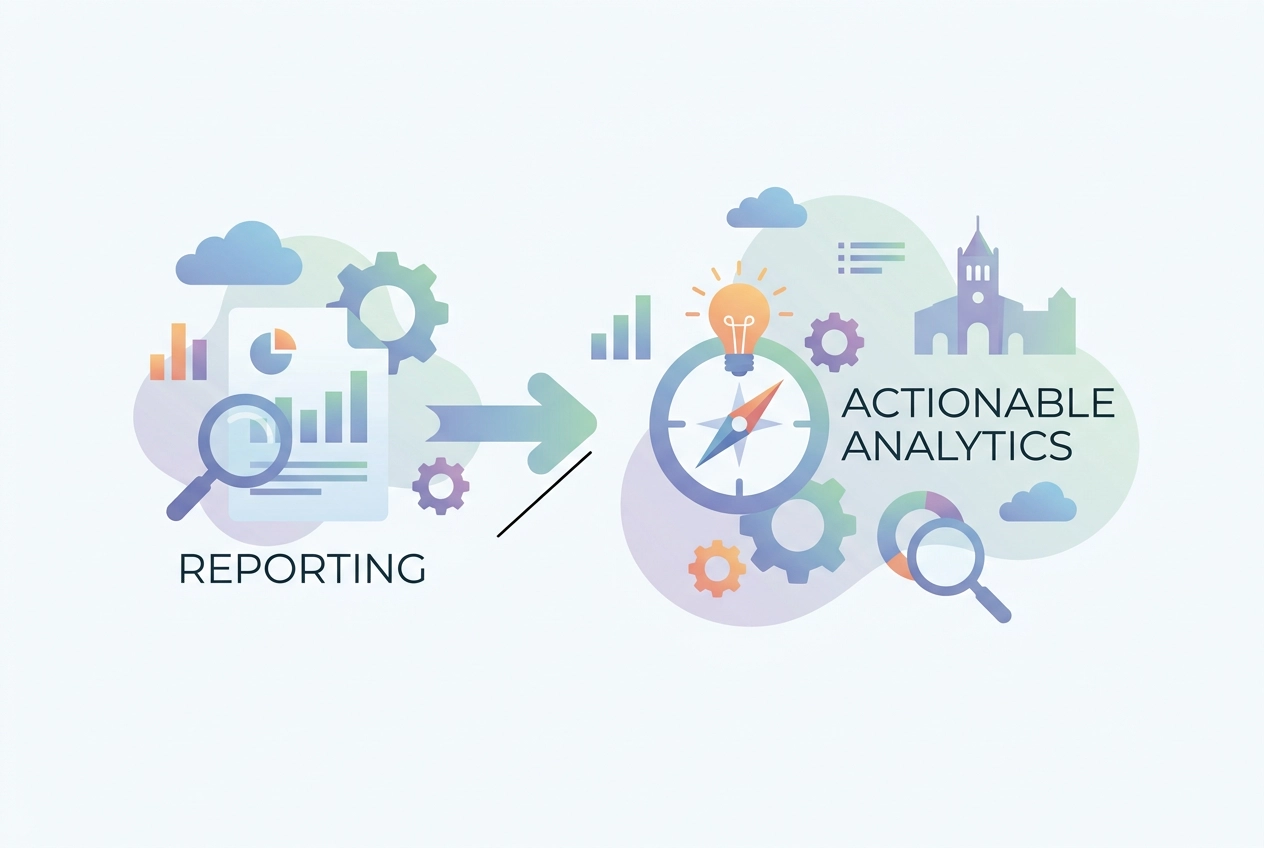
Every month, a PDF lands in your inbox. It has charts, numbers, and maybe a few highlighted metrics your agency wants you to feel good about. Traffic is up. Clicks happened. Impressions were impressively impressive. You nod, file it away, and move on with your week.
But here is the uncomfortable truth: that report is probably not telling you anything useful.
The debate around analytics vs reporting is one that most small business owners never even know exists, and that gap is costing them real money. Reporting tells you what happened. Analytics tells you why it happened and, more importantly, what you should do about it. Those are two very different things, and most agencies are only delivering one of them.
If you run a business in Bakersfield and you rely on a marketing agency or consultant to guide your decisions, this post is for you. We are going to break down exactly what reporting is, what true marketing analytics looks like, show you a real local example, and give you the right questions to ask so you can finally demand the deliverable your business actually needs.
That Monthly Report Is Not Analytics
Picture this: your agency sends over the monthly report. It's a clean PDF, maybe even a nicely designed dashboard. You scroll through it and see numbers everywhere. Website visits were up. Impressions hit a new high. Clicks look decent. Someone even put a little green arrow next to a few of the metrics.
And then you close it and think, "Okay, but what am I supposed to do with this?"
That moment of quiet confusion is more common than you might think, and it is not your fault for feeling it. If a report full of numbers leaves you with more questions than answers, the problem is not your marketing knowledge. The problem is what you were handed.
Here is the truth most agencies won't volunteer: there is a significant difference between reporting and analytics, and many small businesses find themselves getting one when they actually need the other. That gap is where marketing budgets quietly go to waste.
What Reporting Actually Is (And What It Is Not)
So let's actually define the thing. Reporting is a structured summary of what happened over a specific time period. It pulls numbers from platforms like Google Analytics, your ad dashboards, and social media tools, then organizes them into something readable.
Good reporting is consistent, clean, and covers the basics: traffic, clicks, impressions, conversions, and ad spend. Every month, same format, same metrics. Easy to skim, easy to compare period over period. That consistency is genuinely useful.
Here is where it stops, though. Reporting answers one question: what happened? It describes the past. It does not explain causes, and it does not point toward solutions.
A simple example makes this concrete. "Your website traffic dropped last month" is a reporting statement. It is a fact. It is accurate. And it gives you absolutely nothing to act on. Do you pause your ads? Call your web developer? Panic? The report will not tell you.
That is not a flaw in the report, exactly. It is just the nature of reporting. It is a scoreboard, not a game plan.
The important thing to understand is that reporting is not useless. You need the numbers before you can ask better questions about them. Think of it as the foundation of the whole process, the first layer that everything else has to be built on. The problem is not that agencies produce reports. The problem is when the report is where the conversation ends.
What Marketing Analytics Actually Looks Like
So reporting tells you what happened. Analytics tells you why it happened and what to do about it next.
That distinction sounds simple, but in practice it changes everything about how useful your monthly marketing update actually is.
Take the traffic drop from before: a real analytics deliverable doesn't just flag it, it names the cause and prescribes the fix. That gives you context, identifies causation, and points to a next action.
A real analytics deliverable has four things a report alone never will: context (what does this number mean compared to last month or your goals?), causation (why did it change?), cross-channel connections (how do all the moving parts relate?), and specific recommended actions.
That last piece matters because real analytics requires pulling data together from multiple platforms at once. Google Analytics attribution, paid ads data, CRM records, and social metrics all tell part of the story. Look at each channel in isolation and you will miss the patterns that actually explain your results.
Reporting vs. Analytics: A Real Bakersfield Business Example
Let's put this in the real world.
Picture a Bakersfield HVAC company. They're running Google Ads, posting on social media a few times a week, and paying their agency for monthly SEO work. At the end of the month, they get their report. Here's what the two versions of that report look like side by side.
The reporting version:
Website visits up 12%
Ad clicks increased
3 contact form fills recorded
The email says "Great month! Things are trending in the right direction." It feels like a win.
The analytics version of the exact same month:
That 12% traffic increase came almost entirely from branded searches, meaning people who already knew the company were Googling the name directly. No new audience reached.
The 3 form fills all came from one service page that had been recently updated, suggesting that updating similar pages could replicate those results.
Ad clicks went up, but so did cost-per-lead, pointing to a keyword targeting problem that's quietly burning budget.
One version makes you feel good. The other tells you what to actually do on Monday morning.
Here's the structural problem: marketing services are often delivered in silos. The PPC report lives in one PDF. The SEO numbers are somewhere else. Social is its own thing entirely. Nobody is looking at all three together, so the cross-channel patterns stay invisible.
An agency managing only your paid search campaigns genuinely cannot see what your SEO traffic is doing. An integrated agency working across all channels can connect those dots because they have the full picture in front of them.
Why Most Agencies Stop at Reporting
So why does this keep happening? Honestly, it is usually not bad faith. Reporting is just easier to produce at scale, and clients rarely push back or ask for more. If nobody complains about the PDF, there is little pressure to change it.
As shown in the HVAC example above, single-channel access makes cross-channel attribution structurally impossible, not a choice, but a limitation.
Then there is the template trap. Some agencies run the same automated dashboard or PDF format across clients. It looks professional and consistent, which feels reassuring. But a templated report is built around generic metrics, not your specific business questions. You get clean-looking numbers with no tailored insight attached.
The expectation gap makes this worse. If you have only ever received a standard monthly report, you have no frame of reference for what a real analytics deliverable looks like. Many Bakersfield business owners assume the report they are getting is the analytics picture, simply because no one has shown them anything different.
Here is a simple way to check where you stand: if your agency has never explained why a metric changed or told you what to do about it, you have been receiving reporting. That is the honest bottom line.
Questions to Ask Your Agency Right Now
Now that you know what you haven't been getting, here's a simple way to find out where your agency actually stands. Bring these five questions to your next check-in, or use them to size up a new provider before you sign anything.
"Can you tell me why this metric changed last month, not just that it changed?" Any agency can point to a number going up or down. If their answer to why is vague or missing entirely, that's a red flag worth taking seriously.
"How are you connecting our paid ad performance to our organic traffic and our actual sales?" If they answer each channel separately without explaining how they interact, you're looking at siloed reporting. Real marketing analytics and reporting treats those channels as one connected picture.
"What specific action are you recommending based on this month's data?" A reporting-only agency will hedge, generalize, or go quiet here. An analytics-driven partner will have a concrete next step ready, because the whole point of analyzing data is to do something with it.
"Are you using Google Analytics reporting alongside our ad platform data and CRM to track the full customer journey?" This tests cross-channel attribution. Customers rarely convert on their first touchpoint, and GA4's data-driven attribution model is specifically designed to account for that. Single-platform numbers miss the full story.
"What did we learn this month that we didn't know last month?" This is the most telling question of the five. Great agencies treat every reporting period as a source of new strategic intelligence. If the answer sounds like a summary of last month's PDF, it probably is.
Asking these questions isn't confrontational. A good agency partner will welcome them, because it means you're engaged and taking the work seriously. That's exactly the kind of client relationship that produces better results for everyone.
What a Real Analytics Deliverable Should Include
Now that you know the right questions to ask, here is what the answers should actually point toward. If you are paying for true marketing analytics and reporting, your deliverable should have four things in it.
Context and benchmarks. A number without a reference point is just a number. A real analytics deliverable compares this month to last month, to the same period last year, and to whatever goal was set at the start of the campaign. "You got 400 visits" means nothing. "You got 400 visits, up 22% month-over-month and 11% ahead of your seasonal benchmark" means something.
Causation, not just correlation. Your agency should be able to explain why a significant metric moved, not just highlight that it did. Traffic dropped? There should be a likely reason attached, whether that is an algorithm update, a paused ad, or a technical issue on the site. Flagging a change without investigating it is reporting. Explaining it is analytics.
Cross-channel attribution. Every lead has a journey. Someone might click a social ad, leave, find you again through organic search, and then convert through a Google Ads retargeting campaign. Crediting only that last click misrepresents what actually drove the sale and can lead you to cut campaigns that were quietly doing the heavy lifting. Real marketing analytics and reporting traces the full path.
Specific next actions. Every analytics conversation should close with clear recommendations. They do not all have to be major strategic pivots; some will be small optimizations. But if your monthly review ends without a single "here is what we are doing differently next month," you have received a summary, not a strategy.
Wolfpack Marketing structures client reporting around exactly this layer, integrating traffic, conversions, ad performance, and social engagement into a single connected picture rather than four separate summaries. That integration is what makes the next actions actually mean something.
The Bottom Line for Bakersfield Business Owners
Now you know what a real analytics deliverable looks like. So let's bring it home.
The reporting-vs.-analytics gap covered above has a direct cost: many Bakersfield businesses end up with only the first half, and decisions made on incomplete information quietly drain budgets and let real opportunities pass.
You don't need a data science degree to fix this. Start with one simple step: take those five questions from earlier in this post and send them to your agency before your next check-in. The responses will tell you a lot. A team doing real analytics will answer confidently and specifically. A team stuck in reporting mode will get vague in a hurry.
If the answers leave you with more questions than clarity, or if your monthly update has always been a PDF of numbers with no "here's what we're doing about it," that's worth paying attention to. It might be time for a conversation with a team that treats marketing analytics and reporting as the starting point for strategy, not the finish line.
Wolfpack Marketing works with Bakersfield businesses that are serious about becoming the go-to name in their category, and that means turning data into decisions, not just documents. If you're ready to see what that looks like for your business, reach out and start the conversation.
You've got the framework now. Use it.
Conclusion
The difference between reporting and analytics is not a technicality; it is the difference between knowing your numbers and actually growing your business.
You have the framework, now put it to work at your next agency check-in. Ask the hard questions, evaluate the responses honestly, and hold your marketing investment to a higher standard. The businesses that win are the ones making decisions backed by real insight, and that starts with knowing the difference.
Frequently asked questions
- What is the main difference between reporting and marketing analytics?
- Reporting tells you what happened by presenting numbers like traffic, clicks, and impressions from the past. Analytics goes deeper by explaining why those changes happened and, more importantly, what specific actions you should take based on that information. Reporting is a scoreboard; analytics is a game plan.
- Why do most agencies only deliver reporting instead of true analytics?
- Producing reports at scale is easier and requires fewer resources than developing true analytics. Additionally, many agencies work in silos on single channels, which makes cross-channel attribution structurally impossible. There's also little pressure to change when clients don't ask for more or complain about standard monthly PDFs. Templates also make it easier to produce consistent-looking reports without tailored insights.
- What are the four key components a real marketing analytics deliverable should include?
- A real analytics deliverable should include: (1) Context and benchmarks that compare results to previous periods and goals, not just raw numbers; (2) Causation explanations for why metrics changed, not just correlation; (3) Cross-channel attribution that traces the full customer journey across multiple touchpoints; and (4) Specific next actions and recommendations for what to do differently based on the data.
- How can I tell if my current agency is providing true analytics or just reporting?
- Ask your agency these five key questions: (1) Can you explain why this metric changed, not just that it changed? (2) How are you connecting paid ads to organic traffic and actual sales? (3) What specific action are you recommending? (4) Are you using multiple data sources like Google Analytics, ad platforms, and CRM data together? (5) What did we learn this month that we didn't know last month? If answers are vague or each channel is explained separately, you're getting reporting only.
- Why is cross-channel attribution important for understanding marketing performance?
- Cross-channel attribution matters because customer journeys rarely involve a single touchpoint. A customer might click a social ad, later find you through organic search, and convert through a retargeting campaign. If you only credit the last click, you misrepresent what actually drove the sale and may cut campaigns that were quietly doing important work. True analytics traces the full path to understand which channels contributed most to conversions.
Ready for more clicks, calls, and customers?
Let's build a marketing system that hunts leads for your Bakersfield business.